
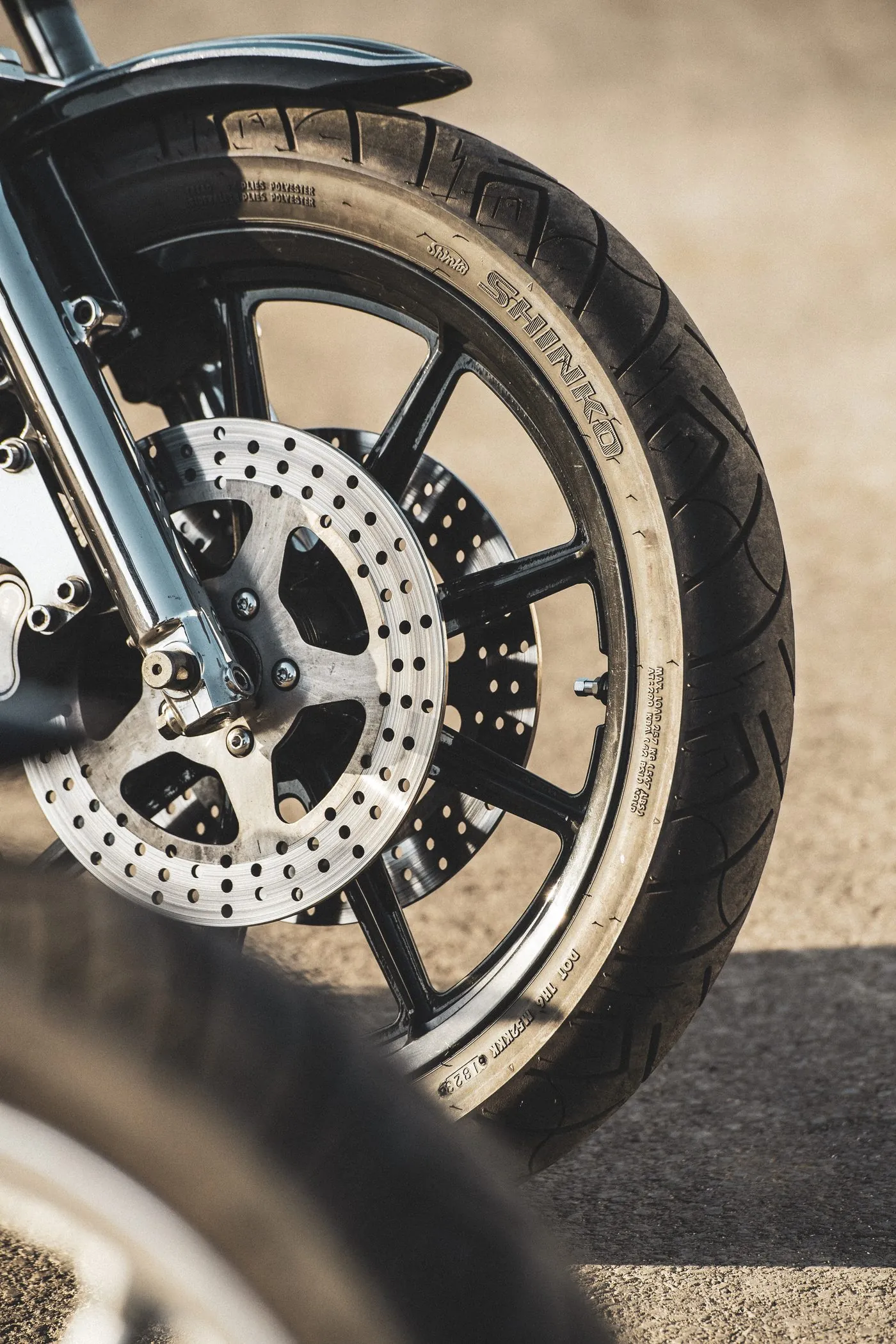
Every tire on the shelf has its whole spec sheet stamped right into the rubber - you just need to know how to read it. The string of numbers and letters on the sidewall tells you the tire's width, profile, construction, load capacity, speed rating, and even how old it is.
Knowing how to read it means you can order the exact right replacement yourself, or double check that what we're putting on your bike matches what came off it. Here's what each part means, plus the one rule that matters most when you're replacing just one tire instead of the pair.
Decoding the Numbers
Take a size like 130/70R18 63H as an example - each piece of that code has a specific job.
Section Width
The first number (e.g. "130") is the tire's width in millimeters, measured at its widest point from sidewall to sidewall. A bigger number means a wider tire.
Aspect Ratio (Profile)
The second number (e.g. "70") is the sidewall's height as a percentage of the tread width. A lower number means a shorter, stiffer sidewall built for sharper handling; a higher number means a taller sidewall built for a softer, more cushioned ride.
Construction Type
The letter right before the rim size tells you how the tire is built. "R" means radial. "B" means bias-belted. No letter at all (just a dash, like 130/70-18) means standard bias-ply. This is the single most important character on the sidewall - see below for why.
Rim Diameter
The number right after the construction letter (e.g. "18") is the wheel diameter, in inches, that the tire is built to mount on. It has to match your wheel exactly - there's no rounding up or down.
Load Index
The number right after the rim diameter (e.g. "63") is a code for the maximum weight that one tire can safely carry at full inflation, based on a standardized chart. Going below the load index your bike calls for isn't a place to save money.
Speed Rating
The letter right after the load index (e.g. "H") is a code for the tire's maximum sustained speed capability, also from a standardized chart. Like load index, it's a minimum spec to match, not a target to beat.
DOT Date Code
Near the DOT stamp, a 4-digit code (e.g. "2324") gives the week and year of manufacture - so "2324" means the 23rd week of 2024. Rubber degrades with age even if the tread looks fine, so this is worth checking on anything that's been sitting a while, including take-offs and old inventory.
Radial vs. Bias-Ply Construction
The construction letter isn't a minor detail - it describes how the tire's internal plies are actually laid out, and it changes how the tire behaves.
Bias-Ply Tires
Built with body plies laid diagonally, criss-crossing bead to bead at roughly a 30-40 degree angle. That crosshatched layup makes the sidewall and tread flex together as one stiff unit, which holds up well to punctures and heavy loads. It's common on cruisers, older and vintage bikes, and a lot of ATV/UTV applications where sidewall toughness against rocks and debris matters more than outright grip.
Radial Tires (R)
Built with body plies running straight across, bead to bead at roughly 90 degrees, with a separate stabilizer belt (steel or aramid) wrapped around the circumference under the tread. That lets the sidewall flex independently of the tread, so the contact patch stays flatter and more consistent through corners - meaning better grip, cooler running at speed, more even tread wear, and a smoother ride. It's the standard on virtually all modern sportbikes and most current street bikes.
Why front and rear need to match: a radial and a bias-ply tire flex in fundamentally different ways under cornering load, so mixing constructions front-to-rear means the two ends of the bike are behaving unpredictably relative to each other mid-corner - one holding its line while the other squirms. That shows up as inconsistent traction, twitchy or vague handling, and uneven wear, and it's exactly why most tire manufacturers and motorcycle OEMs explicitly warn against mixing radial and bias-ply construction on the same bike. If you're only replacing one tire and you're not sure what's on the other end, ask us before you order - we'll match construction (and ideally brand and model) front-to-rear so you're not left guessing.